

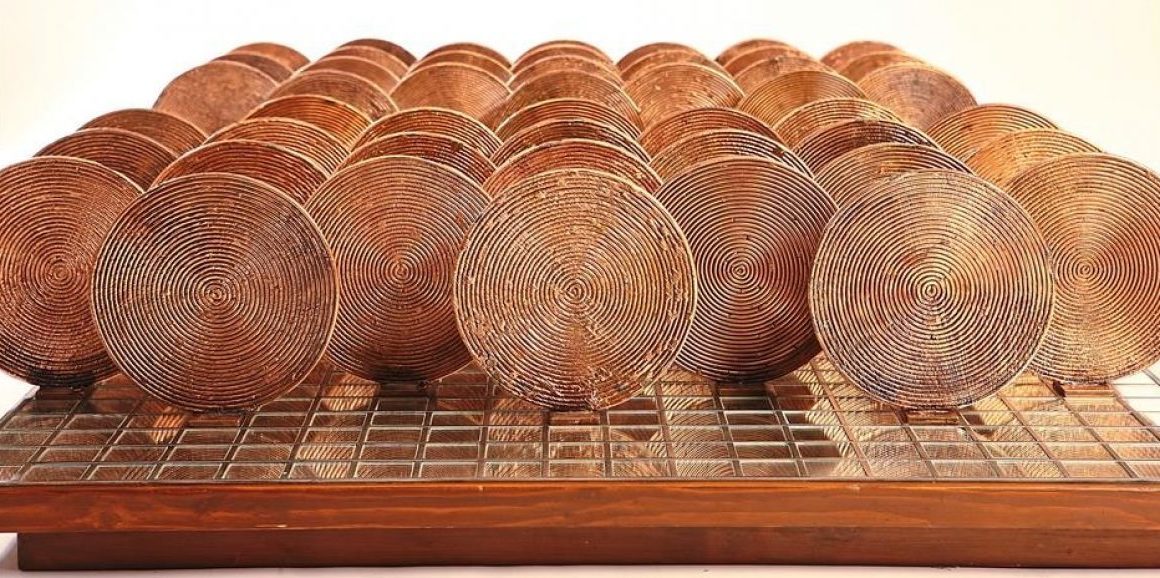
Cosmic Chapati 48: Hunger Game by Amin Gulgee. Photo: Shamyl Khuhro & Jamal Ashiqain
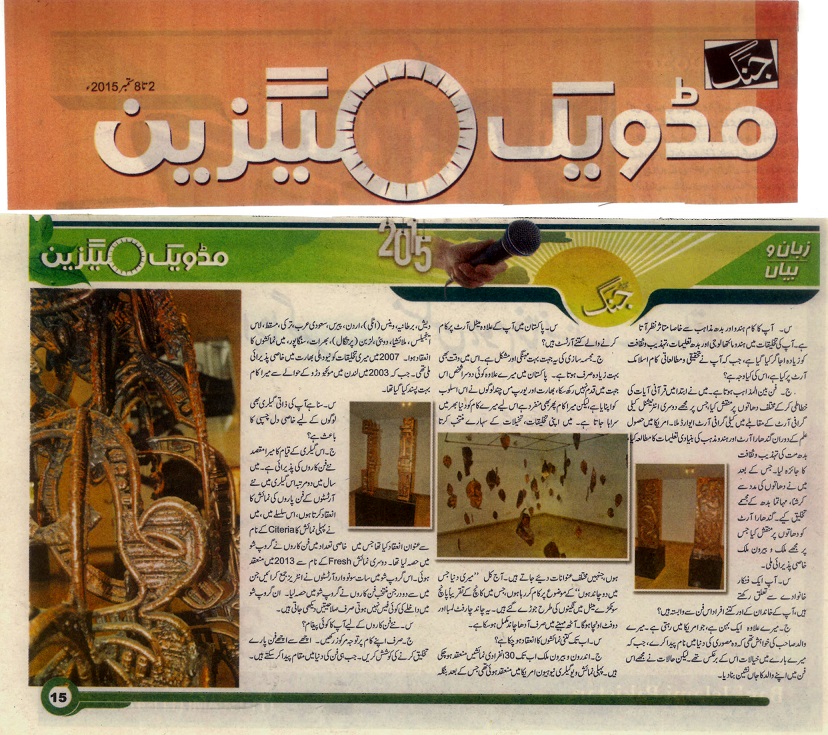
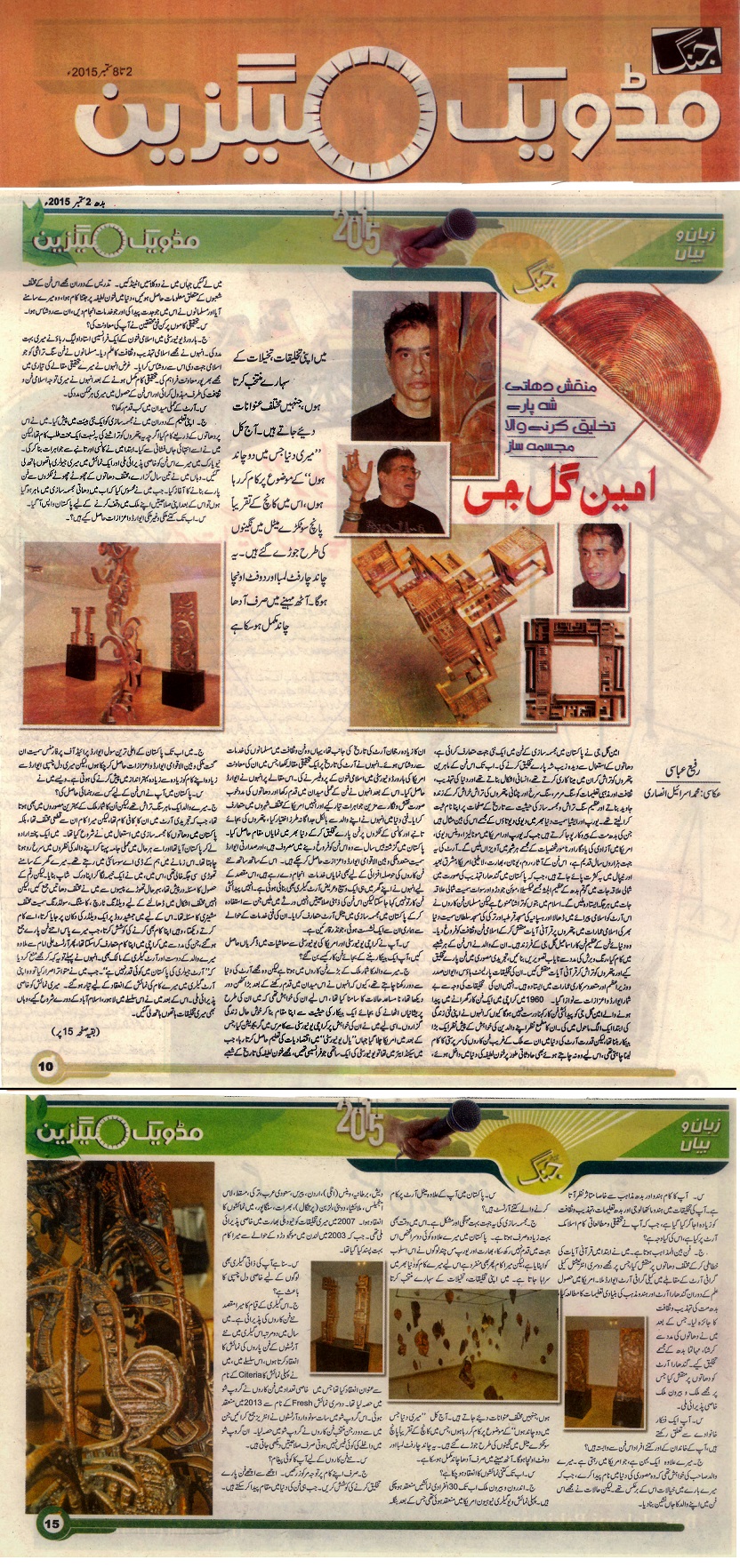
It almost feels like a pilgrimage, a spiritual journey of sorts, ambling through Kuala Lumpur-based gallery Wei-Ling Contemporary, introspectively gazing upon the 25 sculptures of copper and bronze by Amin Gulgee.
The commanding works of the renowned Pakistani sculptor, on display at the gallery till Aug 14, emanate a magnetic otherworldliness.
Each sculpture, painstakingly wrought over the past five years by the 50-year-old, seems to possess its own life and voice, as if they were echoes and whispers from the heavens.
More than that, the voices resonating from the metalwork are of the sculptor’s. Just imagine a meditative chant in the background as you view his new Walking On The Moon exhibition.
“It’s very much my new works in juxtaposition with some older pieces to see how far I’ve come in my journey. That’s the perspective,” says the Karachi-based Amin at a recent interview in Kuala Lumpur.
image: http://cdn.star2.com/wp-content/uploads/2015/07/str2_dkMoon_dineshk_amin.jpg

Pakistani sculptor Amin Gulgee says there is no separation between him and his work. Photo: The Star/Norafifi Ehsan
Wei-Ling Contemporary exhibited Amin’s last exhibition here called Cosmic Mambo in 2011.
image: http://cdn.star2.com/wp-content/uploads/2015/07/str2_dkMoon_dineshk_algorithm-e1436703696609.jpg

Algorithm II by Amin Gulgee. Photo: Shamyl Khuhro & Jamal Ashiqain
His works have toured extensively abroad, including stops in the United States, France, Portugal, Saudi Arabia, Oman and China.
Some art enthusiasts here will also remember his epic solo show Drawing The Line at Galeri Petronas in late 2008.
Amin’s latest exhibition carries a broad range of copper-based works, including horns, calligraphy, architectural design and even the chapati.
This current collection is truly a testament to the sculptor’s unrelenting zeal and passion towards his art.
The artist himself attests to the importance of skill and says he never draws or sketches, as he wants to be “physically, emotionally and intellectually involved in the (creative) process.”
For him, there is no separation between the art and the artist.
“I never want to be removed from it, which is why I have to be at the workshop,” he says.
He adds, cheekily, “The best thing is to get up in the morning and going straight to the workshop. There is no need for a shower because you are going to be covered in grime anyway.”
Amin’s Horn series is a stunning collection of four monumental copper works of water buffalo horns. They, like the great beast of the field, demand respect and reverence.
image: http://cdn.star2.com/wp-content/uploads/2015/07/str2_dkMoon_dineshk_HornSong1-e1436703170752.jpg

Horn Song I by Amin Gulgee. Photo: Shamyl Khuhro Jamal Ashiqain
The horns, imposing in size, could have very well belonged to an ancient temple or a great king for such is their hold.
“The water buffalo is the essence of South Asia. It gives milk, it ploughs the fields and village life runs around this one animal. It is so important. I wanted to highlight that,” reveals Amin, who studied Economics, Architecture and Art History at America’s renowned Yale University.
Moreover, the delicate perforations which Amin had masterfully imbued on the horn sculptures, resemble ceremonial and sacred markings.
In fact, Amin, who opened his own gallery, the Amin Gulgee Gallery in Karachi in 2001, is well known for drawing inspiration from religion.
And it is his three-dimensional calligraphic sculptures which ultimately reflect his prowess as a craftsman. It is interesting to note that Amin’s father, the late Ismail Gulgee, a famous painter and sculptor, was also well known for his calligraphic sculptures. The apple did not fall far from the tree, then.
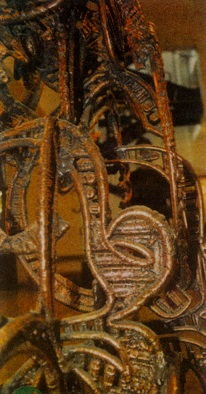
Amin’s calligraphic pieces in Walking On The Moon are a sight to behold. Upon close inspection, you’ll find that the artist deconstructed verses from scriptures and other ancient texts and rearranged the letters, one on top of another, to the point that they are unrecognisable.
image: http://cdn.star2.com/wp-content/uploads/2015/07/str2_dkMoon_dineshk_birdsnest-e1436703267767.jpg

Ripping The Bird’s Nest by Amin Gulgee. Photo: Shamyl Khuhro Jamal Ashiqain
“You can no longer read the script. They are freed, in a way, of content, although I am very aware of where the content is coming from.
“The letters fly upwards. I want them to be free of the earth and dance upwards towards the sky and moon just be free and have this spirit, energy, joy and celebration,” explains Amin.
Another eye-catching work is called Cosmic Chapati: Unknown Centre. The almost metre-long copper sculpture was done, according to Amin, one wire at a time.
“There’s so much chaos, turmoil, war, evil and horror in this world. This is like my meditation, done one wire at a time and it is all about seeking control and balance,” he says.
Ultimately, Walking On The Moon, is an exhibition that reflects the spiritual and psychological psyche of Amin.
In the exhibition’s catalogue, Amin writes with vibrancy and aptly describes his artistic journey.
“My objects are my dreams, my histories and my myths. My work and my life cannot be separated. In both, I need freedom to swim and dance in deep blue space.”
Walking On The Moon is on at Wei-Ling Contemporary at RT01 6th Floor, The Gardens Mall in Kuala Lumpur till Aug 14. The gallery is open Tuesday to Sunday from 11am to 7pm. For more information, visit weiling-gallery.com, call 03-2260 1106 or 03-22828323 or email [email protected].
Source: star2.com
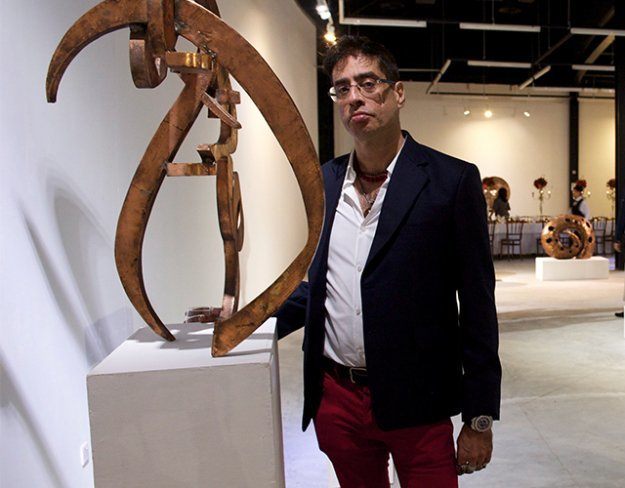
Pakistani sculptor and dreamer Amin Gulgee is back with his fifth solo show at Wei-Ling Contemporary at The Gardens Mall, KL, with an exhibition entitled, Walking On the Moon. No stranger to the art of sculpture, Gulgee has been the subject of over 40 solo exhibitions all over the world since the early 90s. His preferred medium is metal (“I love the smell of copper”) and his creations take from Hindu mythology, Buddhist asceticism and Islamic calligraphy, all important cultural and religious elements of his native country, Pakistan.
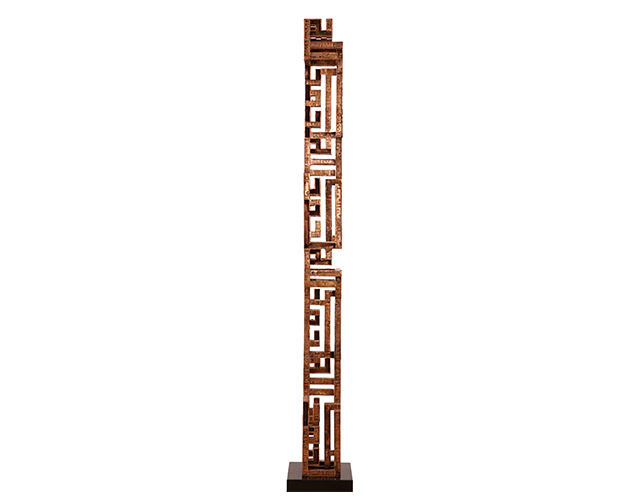
Algorithm I, copper, 2015″There are three lines from the Quran that I use in my work, one of which being ‘God taught humankind what it did not know’,” says Gulgee. “In the early works you can read that line but in the works that you see in this show, you can no longer read it clearly. It becomes more figurative, less literal. My art is my form of meditation. A lot has gone on in my private life; the world has gone crazy these days – the Chapati series, for example, were my attempt to seek order and stability in this world.”
When asked why he chose the chapati, Gulgee explains that “chapati is bread and bread is the essence of life. Right now we live in this really strange world where it’s become so rich that people have become gluten-intolerant, when in my country, most people don’t even have a piece of bread to eat. The chapatti pieces are done one wire at a time. They’re not cast. It’s all about seeking control, seeking calm,” he says.
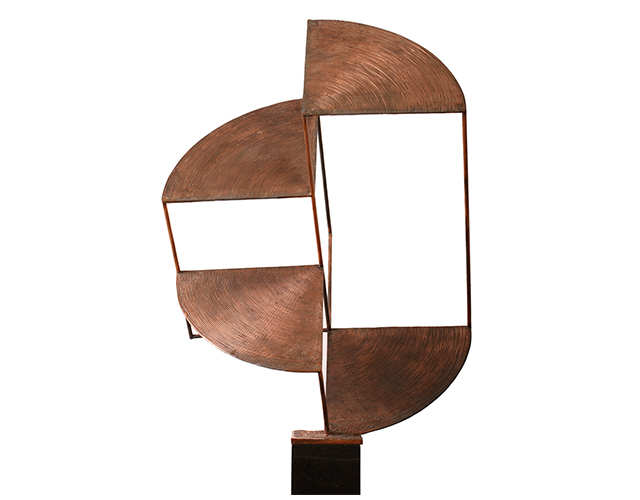
Four Quarter Chapatis II, copper, 2015Gulgee, who graduated from Yale, admits that he did not want to become an artist when he was younger, and that his famous artist father, the late Ismail Gulgee, never wanted or pressured him into becoming an artist. “I was doing economics like a good South Asian boy, but in sophomore year, I went to an art history class and I ended up with a major in it. My thesis was on Islamic Art.”
Growing up, Gulgee was very much influenced by his father’s work. “His idea of bonding was getting me to watch him paint, or for me to paint with him but I decided to explore sculpting as I love objects – form really excites me. Each piece takes me on a journey. Sometimes it may not go anywhere but that’s okay too – my storage space is as big as my work space.”
As for what inspired him, Gulgee says he’s inspired by everything that he sees but these days, is intrigued by (Hieronymus) Bosch’s The Garden of Earthly Delights. Another constant form of inspiration for this artist is dance. “I love dance, I love movement – it’s so primordial. Some of my works, like the Spider Raga and Ascension pieces, you want them to move, you want them flying up, away from gravity.”
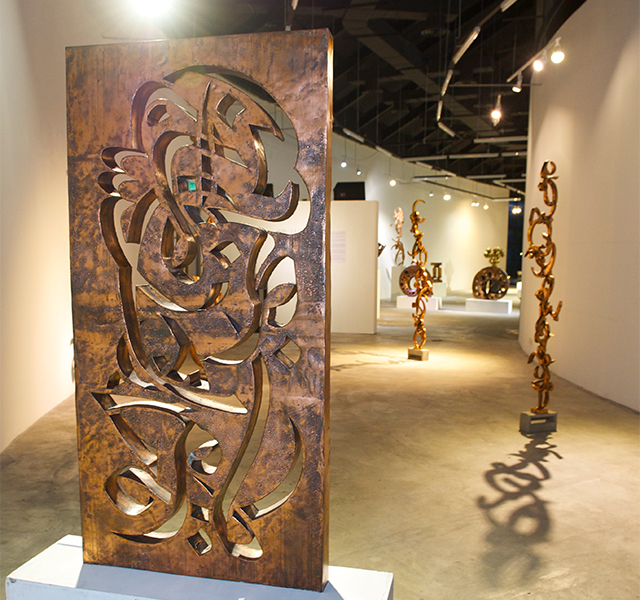
Amin Gulgee’s works on display at Wei-Ling ContemporaryAmin Gulgee’s Walking On The Moon is at Wei-Ling Contemporary from now till 4 August 2015.
Wei-Ling Contemporary, RT01 Sixth Floor, The Gardens Mall, 59200, Kuala Lumpur, Malaysia.
Source: buro247.my
Reality is wrong. Dreams are for real – Tupac Shakur
There is that age-old philosophic, esoteric and almost cryptic argument that asks whether our real everyday lives may in fact be a collective dream and whether our individual dreams in effect might be our actuality.
This was the quasi-premise of ‘Dreamscape’ a two-hour long exhibition of installation and performance art curated by Zarmeené Shah and Amin Gulgee, which wafted in a jarring reverie at the Amin Gulgee Gallery last week. Bringing together almost 50 visual, performance and theatre artists, fashion designers and musicians, the core group of about 35 Karachi-based artists had systematically met through group and separate sessions over a seven-month period with the “curatorial agenda” of enacting a kind of ‘collective dream’ via collaborations. At least a dozen non-Karachiite artists also sent a ‘dreamscape object’ that represented their individual construal of a collective reverie.
“The inspiration came from a Yoko Ono quote: A dream you dream alone is only a dream. A dream you dream together is reality’” explained Gulgee. The exhibition was akin to a workshop cum curatorial exercise in which myriad artists from diverse milieus collaborated in a cross- pollination of ideas which ostensibly affected each other’s work, Gulgee further elaborated.
At the entrance, one was pleasantly met by fashion designer Sadaf Malaterre in a saucy corset dress with Dolly Khan sitting under what looked like a mannequin’s skirt and offering conversation, cupcakes and tea in dainty cups through an interactive installation/performance entitled ‘Tea with Alice.’ This was an indication that the rest of the trip might be either Wonderland or Mad Hatter-like.
And what followed did not disappoint.
Inside the gallery, dancer/choreographer Joshinder Chaggar high up on a pedestal, dressed in a fitted ivory sheath with her fingers painted in autumnal sienna hues representing foliage, writhed sensually in ‘The Autumn leaves’ a movement performance piece inspired by Japanese Butoh dance.
One was then immediately struck by the extensive traffic of socialites, art patrons and performers continually traversing all avenues and corners of the expansive gallery space and at times one could not distinguish players from guests just as in one’s own dreams one cannot control who will appear in them.
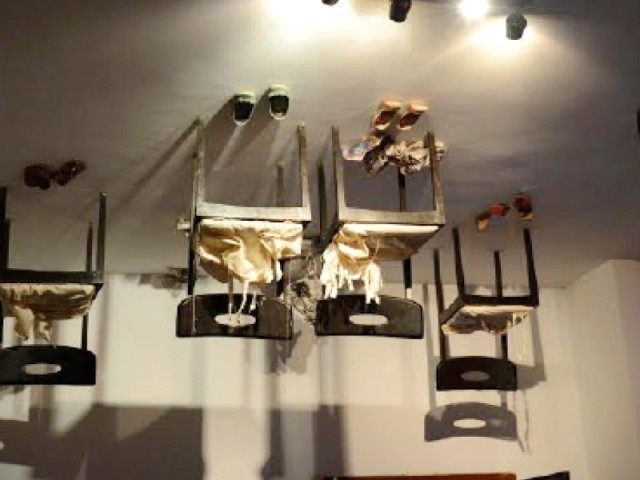
Seema Nusrat’s installation piece ‘Entangled’ had chairs, shoes and newspapers dangling topsy-turvy from the ceiling while Noor Yousuf’s ‘Caged Songs’ was a glorious juxtaposition of cages hanging vicariously over the shifting audience while two men argued over a woman in a performance piece by Umber Majeed entitled tongue-in-cheek ‘Welcome Home’
In the sad light of the tragic and horrific slaughter of 140 lives including 132 children Peshawer, some artists – including Raania Durrani with Zain Ahmed’s piece ‘Bed of Memory’, paid remembrances through their performances and installations. Sitting in grave-like sand dunes and dressed in dark shrouds they dolefully shed sequins and jewels that might have represented letting go of memories and ridding oneself of earthly possessions.
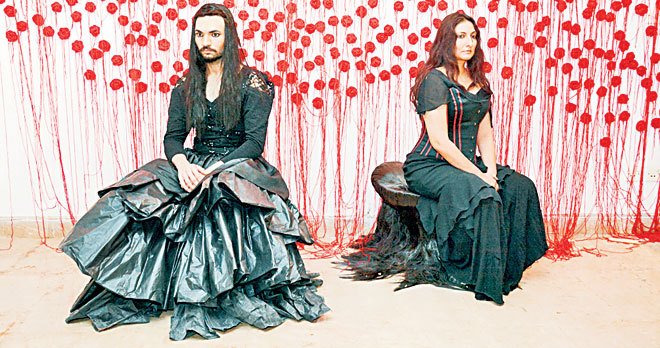
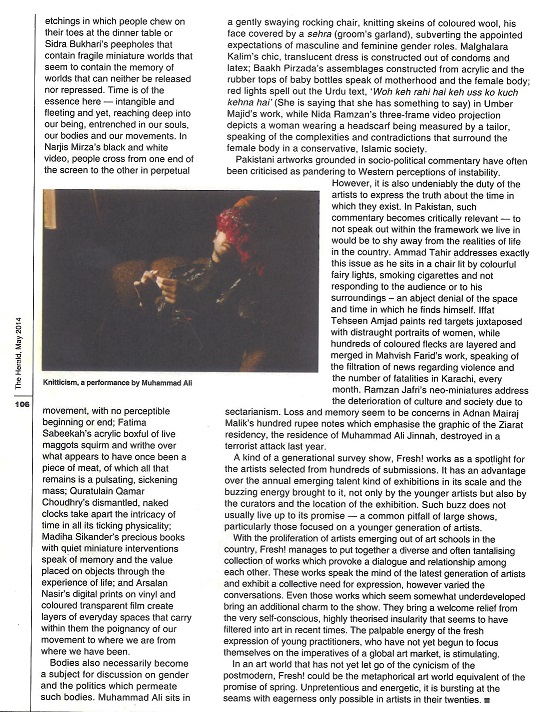
Another artistic duo Muhammad Ali (aka Mirchi Ali), dressed in a woman’s black taffeta ball gown with a similarly dressed Manizhe Ali, also sat in a mise-en-scène of mourning in front of a wall canvassed with blood red roses made of yarn. The piece entitled ‘Bleeding Love’ was an homage to victims of sectarian violence, especially Shia killings and the slain children of Army Public School.

(From Left to Right): Fashion designer Sanam Agha stands under Pomme Gohar’s rain shower that made different personalities express how rain makes them feel inside. Zarmeené Shah and Amin Gulgee, the brains behind the alluring Dreamscape. Vajdaan Shaan dressed as a Malang to highlight the overdependence of humans on clothes and visual appearances in order to define themselves – a harsh but moving reminder to many a fashionista.
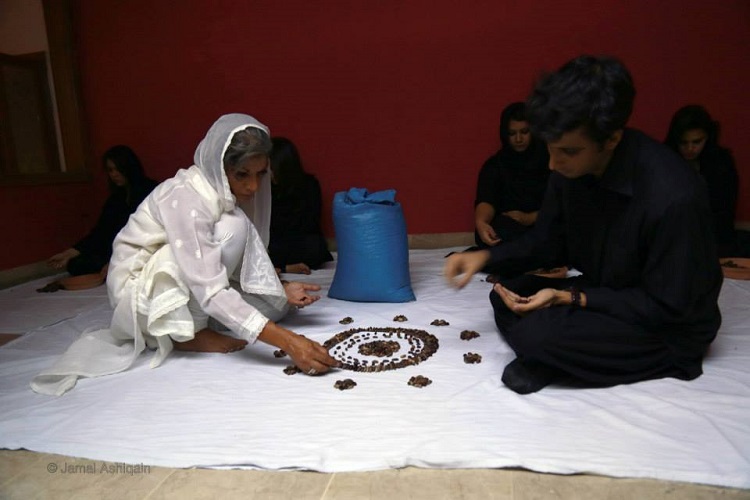
The dour and depression-inducing theme continued with Saba Iqbal’s performance piece, ‘A Way to Somewhere Else’ which recreated a Muslim funeral where a group in mourning sat around in silence counting ritual beans, creating a circular pattern also ostensibly about loss and the continuum of life.
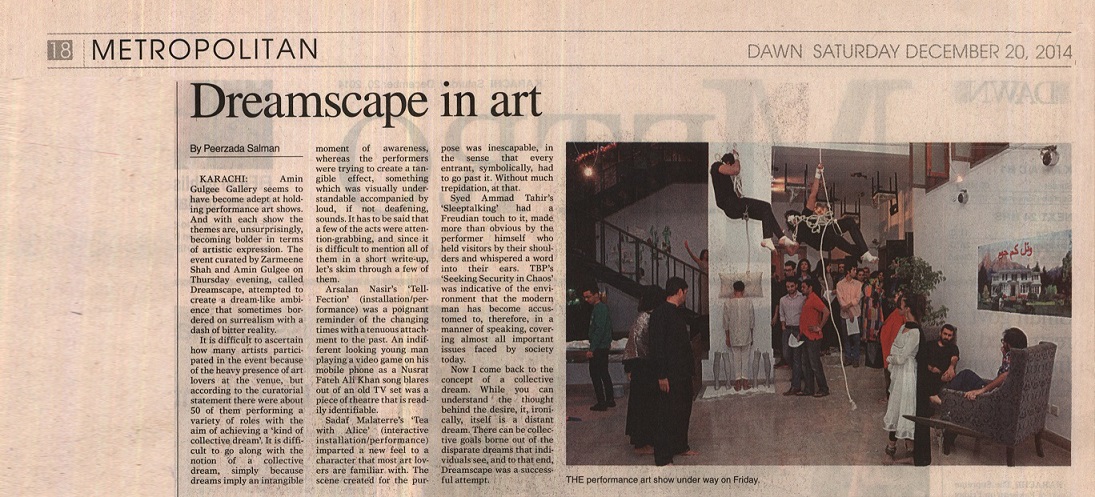
As if to jolt one out of one’s somber reverie, Syed Ammad Tahir, who regularly participates at Gulgee’s performance exhibitions accosted unaware walkers-by and whispered ominous words like “death” “misery” and “pain” into their ears in his performance piece ‘Sleeptalking.’ Tahir’s performance extracted the sounds produced during Acconci’s performance but changed them into audible and comprehensive words according to his own whimsy; words produced as if under REM sleep, a para-somnia more commonly known as sleep-talking.
Three of my favourite artistic endeavours – because they excited myriad senses simultaneously – were executed by fashion designer Fayez Agariah in his installation / performance ‘Paracosmicdisco,’ (sight and touch) mixed media artist and sculptor Sara Pagganwala’s interactive installation / performance ‘Caked’ (sight and taste) and artist Vajdaan Shah’s performance piece ‘Salvation’ (sight and awe!).
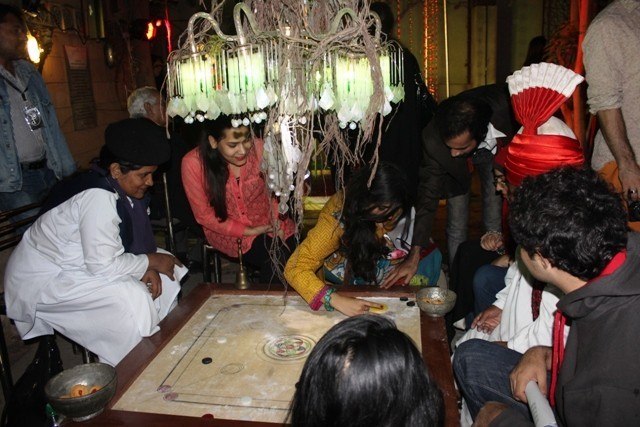
Agariah created a 3D model of a ‘fractal whirlpool that resembled a festive croquembouche made out of an inverted copper tree and embroidery materials such as dabka, kora, naqshi, gota, beads and crystals; forms that moved into a whirlpool towards a central pivot point with a single source of light. Agariah, dressed as a metamorphosing wizard replete with mile-long feathered and colourful lashes canvassed by make-up wiz Beenish Parvez, wore layers of clothing which he disrobed every half hour, beginning with a cape (egg), moving to a feathered costume (caterpillar) until he was left with an exquisite wizard’s jacket and a feathered ruff, accompanied by his partner-in-magic, Saadie Sohail, a fledgling designer for Agariah’s ‘Needful Things’ jewellery line who distributed trinkets to lucky passers-by.

Sculptor Sara Pagganwala made a mould out of her body and turned it into a tempting, scrumptious delight – a chocolate cake with frosting – in her offering titled ‘Caked’.
Pagganwala worked on the premise that to enter within the realm of one’s dreamscape one has to enter the sanctuary of one’s preliminary consciousness and to do so one has to navigate through one’s corporeal being. Pagganwala made a mould of her own body into which she filled a cake mix to create an edible cadaver (a quite delicious chocolate cake covered with pure white frosting of which I greedily ate two slices!) creating a dialogue and a maelstrom energy flow between the artist and the partaker of the cake; an ineluctably intimate and sensual experience with every bite!
Sitting crouched, Malang-like in front of a cauldron, the bearded and near-naked Shah covered in what seems like black tar continued to pour cinders from the remnants of clothing he had torched, plastering the sludge onto himself as a resuscitated salvational garment; an exercise to illustrate and denounce how humans are overly dependent on their clothes and appearance to define themselves. Visually and viscerally this performance moved me deeply, a self-confessed clothes-obsessed fashionista!
Up the stairs and on the mezzanine gallery far from any discord and in one of the more ethereal and “happy” presentations, tranquilly lay Shalalae Jamil (daughter of artist and Art teacher Nayyar Jamil) on a bed, inviting passers-by to lie down with her in a non-sexual way and survey the grey dream projected on the ceiling in the provocative sounding ‘Things that Happen in a Bed#1 which hints at a sequel.
The main gallery could have been dubbed as the ‘celeb hub’ as it held performances and installations by more mainstream, well-known “celebrities” such as Sarwat Gilani, Angeline Malik, Sikander Mufti with his pretty wife Benish Mahmood and Nadia Hussain.
Dressed in hip sporty garb and sunglasses, in the amusing and theatrical piece ‘Shut Up and Run,’ Gilani runs intermittently on a treadmill which she sees as guiding her presumably towards career, marriage and a future. She heaves and wheezes through the paces daily. Between pants she self-motivates with exclamations of ‘this is my path…this is the way I’m going to get there…to happiness…to success’ until she stops herself and exclaims ‘Oh just shut up and run!’ The treadmill in default mode is actually a crutch and is the very obstacle in her way of living a real life spontaneously. Gilani also personalized the performance by delving into her own life and in one instance exclaiming ‘divorce’ and ‘mahram’ before laughing derisively.

Sikander Mufti treated audiences to his interpretation of the experience one faces after waking up from deep dream-state through a collection of symbolic images.
In ‘Unremember,’ Sikander Mufti with Benish Mahmood ask, “if dreams are so memorable, why does one forget? If forgotten, why do they recur?” and is a description of what the artist experiences upon awakening from deep dream-states. The installation comprised of an arrangement of images and objects that were symbolic of the dream-noise that has accumulated in the artist’s mind including Mahmood cutting images from photographs and diligently positing them in different juxtapositions in a repetitive loop with a suited male character berating her with a book in hand. The projection on the wall depicts a descent from the higher state of consciousness one achieves during dreams, towards the clouded state that we spend our waking lives in and what we perceive as “reality”. Mannequins depict the myriad “faceless” visages that the artist’s dreams have generated over the years, mere constructs of the subconscious. The television with white-noise playing may represent hope that the artist’s accumulated dream-noise might at some point tune to become clear narratives that he can relate to others.
Angeline Malik’s performance ‘Dreams and Faceless Masks’ was a discourse on how we all travel throughout life with one thing in common: we all wear the same faceless masks which can only be distinguished through taste, smell and touch. To this effect Malik continued to make plaster casts of her model Mahirah Abbasi’s face and arms in a calm, soothing and tactile manner.
Nadia Hussain’s rather dramatic if not a tad bit lazy installation ‘Heart on a Plate’ boldly posited an oversize heart on a piece of crockery, perhaps to illustrate how love needs to be both sacrificial and offered easily, with visitors estimating the heart’s provenance or whether it was real. I touched it and it was indeed fleshy, a friend suggesting it might have belonged to a camel due to its large size!
Literally the most bracing and energizing installation/performance was ‘Rain Shower’ by Pomme Gohar. Buoyed by the mantra “Don’t let anyone rain on your dreams” Pomme had different personalities including fashion designer and actress Sanam Agha, businesswoman and philanthropist Tara Uzra Dawood, London-based fashion designer and fledgling actor Danish Wakeel and even the once tar-covered Vajdaan Shah enact what cleansing and healing rain meant to them and how it made them feel. They stood under a bucolic, lit rain shower: the practical businesswoman Dawood needing an umbrella; the super-ambitious Wakeel reveling with confidence and the filmi dressed Agha romancing the rain in a sari and a dupatta-veiled dulhan ( bride) literally exulting in a bridal shower!
Apart from purely visual performances ‘Dreamscape’ comprised of ‘music’ performances including ‘Dancing Nancies’ by Ali Junejo and a ‘sound’ interactive piece ‘Seeking Security in Chaos’ by the collective TBP comprising of mixed media installation/sound/performance artists, Zeerak Ahmed and Abdullah Tariq Khan and mixed media installation/game developer/sound producer Danial Hyatt who explored the trauma of being ripped away from the womb and our repeated attempts to reconnect with all that is lost by tapping into our emotions as they slowly and inevitably slip away.
Furthermore, what was impressive about the curatorial abilities of both Zarmeené Shah and Amin Gulgee for ‘Dreamscape’ was the mining of noted and veteran fine and mixed media artists and sculptors including Meher Afroz with Yasir Hussain for the performance ‘Khushbu’ and installation ‘Qareene’ respectively, David Alesworth’s expansive digital print ‘Garden of Babel,’ Huma Mulji’s peripatetic installation with digital prints ‘Ward,’ Aasim Akhter’s interactive installation ‘Tryst with a Tree’ and Quddus Mirza’s quixotic object ‘Anti-clockwise.’
If there was one flaw with ‘Dreamscape’ it was the absence of a guidebook of artists’ statements so as to elucidate audiences of their artistic intent. Explained Pomme Gohar, whose company Phenomena also helped to coordinate and put ‘Dreamscape’ together, “We had planned on putting together a booklet with all the artists’ interpretative statements but funding fell short. Nowadays sponsors are open to release funds for Fashion events but not for Art.”
But however impressive and personal each artist’s interpretation of dreams was, and each indubitably created a decisive impact, Willie Wonka said it best: “We are all the makers of dreams, the dreamers of dreams.” Everyone can relate to that.
By Zürain Imam – December 28, 2014
Source: tns.thenews.com.pk
Muhammad and Manizhe Ali sat in mourning wearing black with a backdrop of a wall covered in roses made of yarn. The piece was dedicated to the children who had lost their lives in Tuesday’s militant attack. PHOTO: COURTESY AMIN GULGEE GALLERY
KARACHI: Walking through the skirt of a mannequin, on Thursday, was like stumbling into a never-ending dream. The first thing you saw two women having a tea party very similar to the one held by the Mad Hatter.
A few steps ahead, Summayya Jillani was painting on people – creating a live painting by using the audience as her canvas. Her performance piece was titled ‘This is Not a Painting’ and was not something she usually works with.
Leaving Jillani behind and walking into the Amin Gulgee Gallery, the world seemed to turn upside down with Seema Nusrat’s piece ‘Entangled’. The installation was hanging from the ceiling – chairs, shoes and newspapers made one feel like they were on the set of Christopher Nolan’s Inception. It looked like anything and everything was possible.
These performance and installation pieces were part of a seven-month effort made by 50 artists, including 35 Karachi-based artists and was curated by Zarmeene Shah and Amin Gulgee.
The crowd, limited space and a lot of art made it feel like the audience was lost in a Dreamscape – which lasted two hours and was also the name of the show.
“It is a cross pollination of ideas,” said Gulgee while explaining how one artist’s work affected others. “The inspiration came from a Yoko Ono quote, ‘A dream you dream alone is only a dream. A dream you dream together is reality’.” He added that the event was like when a workshop meets curation – a place where theatre artists, fashion designers, musicians and fine artists collaborated with each other.
There was no time for monotony or stillness as the art kept moving. From bumping into the artists who were hanging on ropes attached to the ceiling in a piece ‘The Sound of Silence’ by Sunil Shankar and Kashif Hussain, to stumbling upon two men fighting over a woman in the act ‘Welcome Home’ by Umber Majeed.
There were nearly 50 pieces of art everywhere, including, Raania Durrani and Zain Ahmed’s performance piece ‘Bed of Memory’ which was about Tuesday’s incident in Peshawar where more than 140 lives were lost. They shed their jewels – which depicted the act of letting go and loss. They initially started working with the idea of memory and when militants attacked the Army Public School, they were so moved by it that they decided to make it about loss and collective mourning. Saba Iqbal’s performance piece, ‘A Way to Somewhere Else’ was also about loss. A group of artists wearing white clothes were sitting in mourning at a funeral in silence. Muhammad and Manizhe Ali also sat in mourning wearing black with a backdrop of a wall covered in roses made of yarn. The piece was dedicated to those who had lost their lives in sectarian violence and the 132 children of Peshawar who died in Tuesday’s militant attack.
Just when one left the mourning reverie, Ammad Tahir ‘Sleep Talking’was a chilling experience. He kept walking around and whispered words like death and pain into the ears of anyone who he came across.
Bilal Nasir Khan’s interactive installation ‘Centre of Gravitiy’, was all about music and movements. Using a web programme which registers movements through a webcam – Khan converted the audience’s movement into music.
Away from the music and movements, was a bed inviting the audience the chance to lie down with the artist and watch a dream projected on the ceiling in Shalalae Jamil’s ‘Things that Happen in a Bed#1.’
“I’m happy to see such engaging art and performances happening here,” said Humayun Memon, a photographer. “This is definitely a first for Pakistan. Not sure if we have had such a massive collective of major performance / installation pieces in one place.”
By Munira Abbas – Published: December 21, 2014
Published in The Express Tribune, December 21st, 2014.
Source: tribune.com.pk
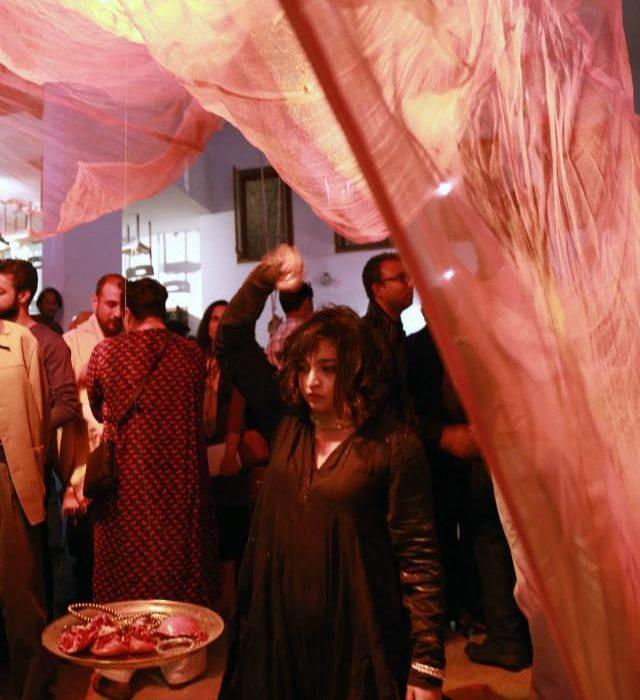

Dreamscape, a performance and installation art evening, was held at Amin Gulgee Gallery, Karachi, with the curatorial theme of “collective dreaming”.
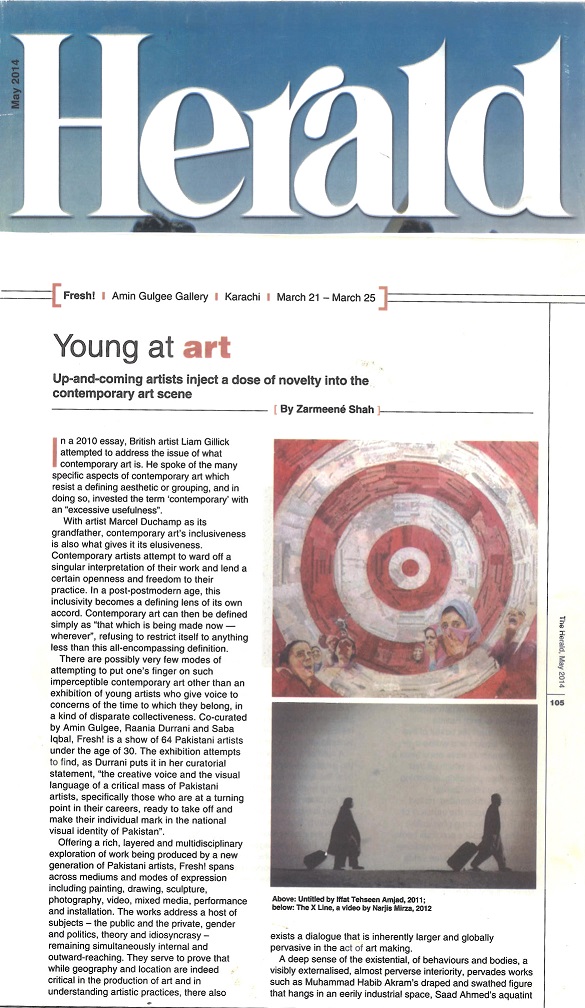
Amin Gulgee Gallery has become a pioneer of performance and live installation art with ‘Dreamscape’, its third such show. The first exhibition of this sort took place in 2013 and was fittingly called ‘Riwhyti: One Night Stand,’ featuring performances on issues surrounding birth, death, and marriage. ‘Fresh’, which took place earlier this year, focused on young artists, all under thirty, and featured a mix of two-dimensional, three-dimensional and performative works from cities and rural locales all over Pakistan. A survey of contemporary art being produced by artists at a turning point in their career, the “conceptually and technically resolved works” highlighted the “creative voice and visual language of a critical mass of Pakistani artists”, said Amin Gulgee.
‘Dreamscape’, which took seven months of discussion with the artists and curation by Amin Gulgee and Zarmeene Shah to produce, brought together performers from various fields, including theatre, television and fashion design. The exhibition, which took place two days after the deadly attacks in Peshawar, saw many artists, such as Muhammad Ali and Manizhe Ali, reconfiguring their works to comment and circle around questions of mourning and memory.
The artist statement opened with a quotation from Yoko Ono: “A dream you dream alone is only a dream. A dream you dream together is reality.”
The curatorial statement in full:
“Curated by Zarmeene Shah and Amin Gulgee, Dreamscape brings together almost 50 visual, performance and theatre artists, fashion designers and musicians in an exhibition of installation and performance art. Fostered through regular individual and group meetings with the core group of about 35 Karachi-based artists over a seven-month period, with the curatorial agenda finding its basis in enacting a kind of ‘collective dream’, artists have formed visible connections and collaborations alongside the production of individual works created specifically for this show. More than a dozen artists from out of station have also been invited to send a ‘dreamscape object’ that represents their individual interpretation of our collective reverie.”
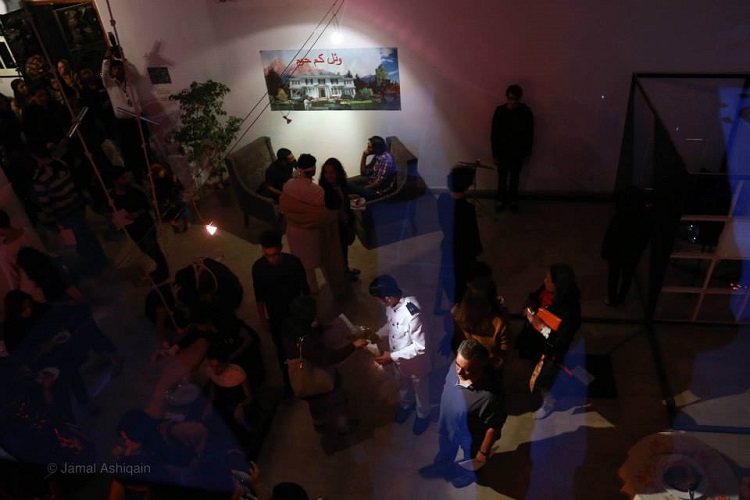
Images courtesy of Jamal Ashiqain.
Source: artnowpakistan.com
By Farhan Khan
Karachi: An exhibition of installation and performing art with the theme of Dreamscape was held on December 18, 2014 at the Amin Gulgee Gallery. The event was curated by Zarmeene Shah and Amin Gulgee; it brought together almost 50 visual, performance and theater artists, fashion designers and musicians.
Amin Gulgee briefed that through regular individual and group meetings with the core group of about 35 Karachi-based artists over a seven month period, with the curatorial agenda finding its basis in enacting a kind of collective dream, artists have formed visible connections and collaborations alongside the production of individual works created specifically for this show. Amin further added that more than a dozen artists from out of station had also been invited to send a dreamscape object that represents their individual interpretation of our collective reverie.
Amin Gulgee, the son of late legendary artist Ismail Gulgee, is counted among the leading sculptor of Pakistan. His inspiration is the varied and rich spiritual history of his motherland Pakistan. In the last ten years, his work has been exhibiting in different places of the world. His work has followed many different directions, from the purely abstract to work that is inspired from Hindu mythology, Buddhist civilization and Islamic calligraphy. Although diverse, these directions influence and nourish one another for they all attempt to depict the spirituality of man.
Well-established in Pakistan, the artist has also exhibited extensively in the USA, Europe and the Middle East. The artist’s forty-odd shows include Prima Esposizione di Sculture e Installazioni in Venice, where he participated alongside Cesar and ten other international sculptors with a solo show at the IMF Gallery in Washington.
Source: liverostrum.com
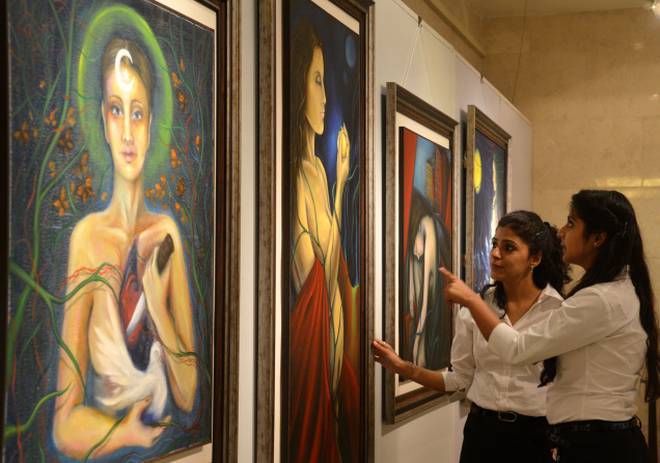
After the hustle and bustle of lifestyle show Aalishan Pakistan, walking into The Art Junction at The Lalit to view the exhibition titled ‘Pakistan Art Today’ is an extremely soothing experience.
Fifty-two works by 11 contemporary artists from across the border touch on numerous themes and use a variety of styles to get the viewer thinking.
The exhibition, curated by MyArtWorld, was inaugurated by artist, sculptor and architect Satish Gujral. The participating artists are Amin Gulgee, Ali Azmat, Tapu Javeri, Scheherezade Junejo, Summaiya Jillani, Dua Abbas, Zehra Javeri, Ramzan Jafri, Sahyr Sayed, Syed Shahabdullah and Rabia Ajaz.
From artist Dua Abbas’ use of medieval religions iconography to Summaiya Jillani’s pop-culture inspired whimsical creations, the works convey messages in the most subtle ways.
Tapu Javeri’s canvases incorporate the buildings of Karachi into kaleidoscope-like images of what are shamiana designs.
Artist Ali Azmat’s works are a collaboration with his four-year-old daughter Ada. They have shared the canvass to come up with a unique line showing the bond between father and daughter.
Rabia Ajaz’s works are inspired by the meat markets of Lahore, while Sahyr Sayed takes you back to your childhood with her miniature art works inspired by her doll house. There is even a copper sculpture made by Amin Gulgee.
At the inauguration of the event, a big canvas was placed for artists from both countries to express their feelings. This canvas will later be auctioned and the proceeds from the sale will go to support a charity.
The works definitely give the viewer a glimpse into the art scene in Pakistan and offer a peek into the creative mind and expression of contemporary Pakistani artists.
Source: thehindu.com
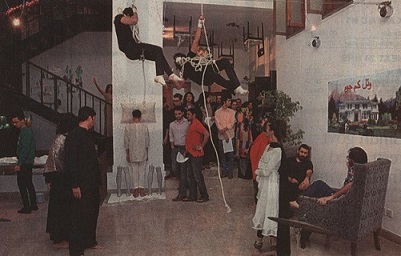
Muhammad and Manizhe Ali sat in mourning wearing black with a backdrop of a wall covered in roses made of yarn. The piece was dedicated to the children who had lost their lives in Tuesday’s militant attack. PHOTO: COURTESY AMIN GULGEE GALLERY